
AI can research, draft, translate, and analyze faster than any marketing team in Lansing or Grand Rapids. Used carelessly, it can also get your pages demoted and your reviews removed. These AI techniques for Michigan marketers build rankings and customers, with the rules that keep you safe.
Key takeaways
- Google does not penalize content because AI helped make it. It penalizes low-value pages made at scale to manipulate rankings [1] [3].
- Use AI to widen keyword lists, draft, translate, and read your data. Never use it to estimate search volume or write reviews.
- Consumers are using AI tools for local recommendations much more than a year ago [5], so showing up in AI answers is now part of local SEO.
- Standard SEO is still the foundation for AI search. You do not need llms.txt files or special markup [2] [17].
- Michigan has its own AI rule for political ads, on top of federal rules for reviews [9] [14].
In this guide
- Where AI marketing stands in 2026
- AI keyword research
- AI drafts, Michigan experts finish
- Showing up in AI answers
- AI and reviews
- AI translation for Dearborn and beyond
- AI-built seasonal campaigns
- Let AI read your data
- Copy-ready prompts
- AI rules every Michigan marketer should know
- How AI helps you profit more
- A 90-day AI roadmap
- 10 frequently asked questions
Where AI marketing stands in 2026
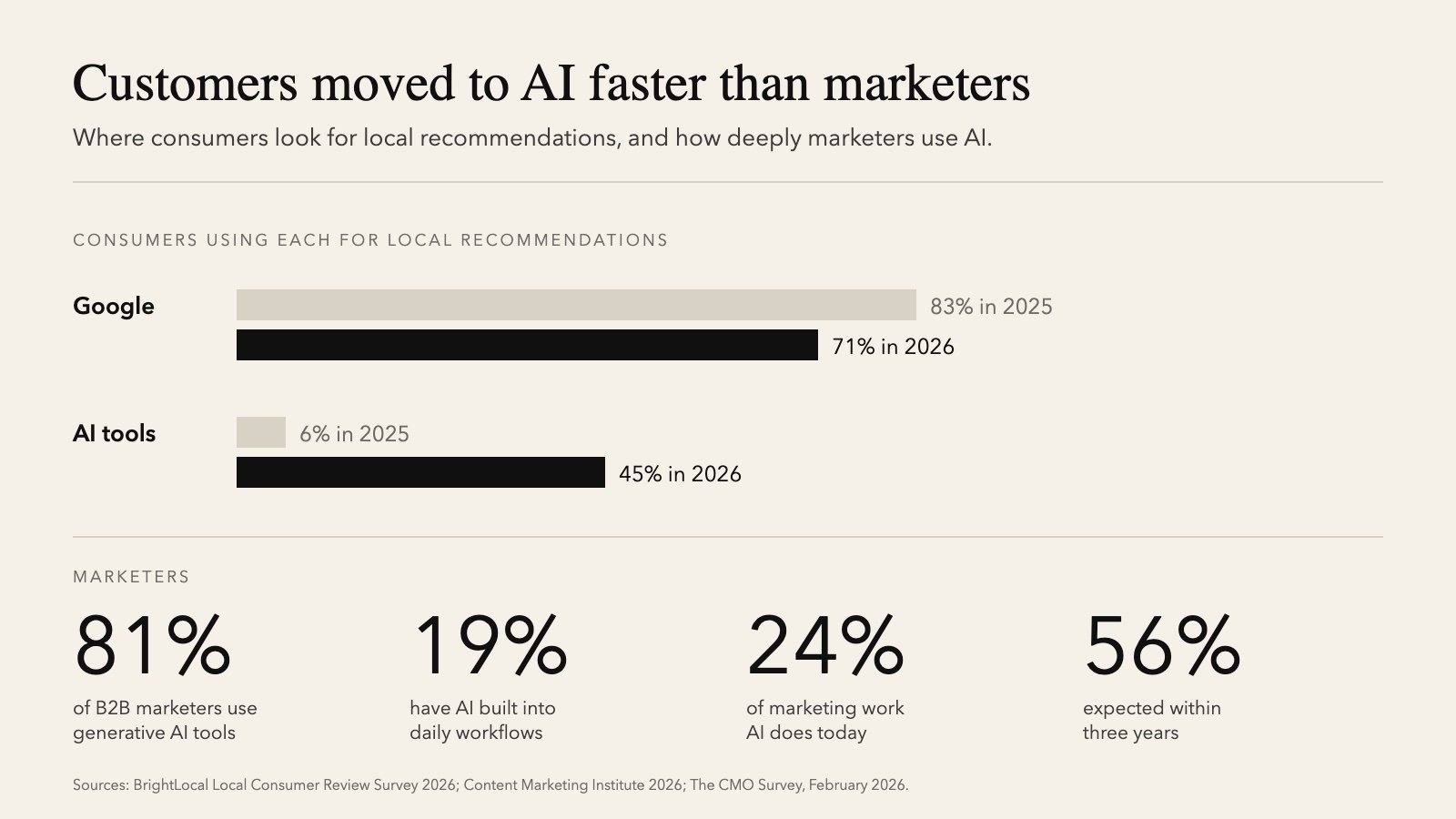
Most marketers have AI tools. Few have AI workflows. The Content Marketing Institute’s 2026 research found 81% of B2B marketers use generative AI tools, but only 19% say AI is built into their daily processes [7]. The CMO Survey found AI handles about 24% of marketing work today, and leaders expect that to reach about 56% within three years [8].
Customers moved faster. BrightLocal’s 2026 survey found 45% of consumers now use AI tools like ChatGPT for local recommendations, up from 6% a year earlier [5]. For Michigan marketers, that gap is the opportunity: build a real AI workflow while competitors are still experimenting.
Technique 1: AI-assisted Michigan keyword research
AI is excellent at brainstorming how Michiganders phrase searches: by county, by region, by season, and with local words like “Up North” or “party store.” It is not a source of search volume. Use AI to widen the list, then confirm every phrase in Google Search Console or Keyword Planner. For the full keyword playbook, see our Michigan SEO tactics guide.
| Task | Use AI? | Why |
|---|---|---|
| Brainstorm regional and county variations | Yes | Fast coverage of “Oakland County,” “Downriver,” “West Michigan,” and similar phrasing |
| Group keywords by intent | Yes | Separates urgent searches (“emergency furnace repair Warren”) from research searches |
| Estimate search volume | No | Language models invent plausible numbers. Get volume from real tools. |
| Map keywords to existing pages | With review | A useful first pass. A person should check that two pages are not targeting the same term. |
Technique 2: AI drafts, Michigan experts finish
Google’s guidance says generative AI is useful for researching a topic and structuring original content, but generating many pages without adding value may violate its scaled content abuse policy [1] [3]. Google also applies its spam policies to AI Overviews and AI Mode [4].
The trap for Michigan businesses is the fifty-city location page. An AI tool can write a page for every town from Monroe to Marquette in an afternoon. Unless each page carries real local proof, those pages are exactly what the policy describes.
| Workflow | Risk | What makes it work |
|---|---|---|
| AI outline, human-written page with local projects and photos | Low | Original experience only your team has |
| AI draft edited and fact-checked by a named expert | Low | Accountability and accuracy, including titles and meta descriptions |
| AI location pages with bracketed facts filled in by staff | Medium | Only publish pages where you have real local detail |
| Auto-published AI pages for every Michigan city | High | Matches scaled content abuse. Do not do it. |
Selling online? Google’s guidance notes that Merchant Center requires AI-generated product images to carry IPTC metadata marking them as AI-made, and AI-generated product titles and descriptions to be labeled [1].
Technique 3: Earn a spot in AI Overviews, AI Mode, and ChatGPT
In May 2026, Google published a guide to optimizing for its generative AI search features. Its message: standard SEO remains the foundation, and tactics like llms.txt files, special markup, or chopping content into tiny chunks are not needed [2] [17]. For local AI visibility, on-page content, reviews, and citations lead the signals in Whitespark’s 2026 survey of local SEO experts [6]. In practice:
- Answer Michigan questions directly. “How much does it cost to winterize a cottage in Northern Michigan?” Lead with the answer.
- Publish what AI cannot copy. Your prices, project photos, local case studies, and staff expertise [16].
- Keep your Google Business Profile accurate. Name, categories, and hours must match the real business [18].
- Test your visibility monthly. Ask ChatGPT, Gemini, and Google AI Mode for the “best [service] in [your city]” and log who gets named.
Technique 4: Use AI on reviews, never for reviews
AI is useful for replying to real reviews and spotting patterns across hundreds of them. It must never write the reviews. The FTC’s rule, in effect since October 2024, bans fake reviews and testimonials, including AI-generated ones, and bans paying for reviews that express a particular opinion. Violations can bring civil penalties of more than $50,000 each [9]. Google also removes paid or incentivized reviews as fake engagement [10].
| Task | Risk | Guardrail |
|---|---|---|
| Draft replies to real reviews | Low | A person edits and posts each reply |
| Summarize themes across reviews | Low | Feed the findings back to operations |
| Write review request texts | Low | Ask every customer and offer no incentive |
| Generate reviews or testimonials | Prohibited | Illegal under the FTC rule |
Technique 5: AI translation for Dearborn and beyond
Michigan’s multilingual markets are large. Census data shows a majority of Dearborn residents now report Middle Eastern or North African ancestry [11]. AI translation makes serving that audience affordable, but only as a first draft. Have a native Arabic or Spanish speaker review every page, then connect the language versions with hreflang tags, which Google accepts in HTML, HTTP headers, or sitemaps [12].
<link rel="alternate" hreflang="en-us" href="https://example.com/dearborn/[service]/" />
<link rel="alternate" hreflang="ar-us" href="https://example.com/ar/dearborn/[service]/" />
<link rel="alternate" hreflang="x-default" href="https://example.com/dearborn/[service]/" />
Include the same set of tags on every language version of the page.
Technique 6: AI-built seasonal campaigns
Michigan’s seasons drive search demand, and tourism amplifies it: the state drew about 130 million visitors who spent roughly $30 billion in 2024 [13]. AI can turn one campaign brief into ad variations, email subject lines, and social posts for each season in minutes. Let it produce options, then have a person pick what fits your brand and check every date, price, and event name.
| Season | Michigan demand | AI task | Publish by |
|---|---|---|---|
| Winter | Furnaces, snow removal, ski trips | Emergency-service ad variations | Mid November |
| Spring | Roof repair, landscaping, trout opener | Spring-prep FAQ drafts | Mid February |
| Summer | Lake season, festivals, Up North travel | Itinerary and event page outlines | Mid April |
| Fall | Color tours, cider mills, deer season | Email and social variations | Mid July |
See the full month-by-month Michigan search calendar.
Technique 7: Let AI read your data
Export a Search Console performance report and ask an AI tool to find queries with Michigan city and county names, pages with many impressions but few clicks, and seasonal patterns. Do the same with review exports and call logs. Always check the AI’s math against the raw export before acting on it.
| Data source | Question to ask |
|---|---|
| Search Console query export | Which Michigan place-name queries bring impressions but few clicks? |
| Google Business Profile performance | Which months drive the most calls and direction requests? |
| Review export | What are the top five praise and complaint themes by location? |
| CRM or booking data | Which service pages produce paying customers, not just traffic? |
Technique 8: Copy-ready AI prompts for Michigan marketers
Replace anything in [brackets] with your details. Each prompt tells the AI not to invent facts, which keeps the output safe to edit and publish.
Keyword brainstorm
You are helping a [business type] in [city], Michigan. List 30 search phrases local customers might use, grouped into: county names, regional terms (Metro Detroit, West Michigan, Up North, the U.P.), seasonal modifiers, and urgent versus research intent. Do not estimate search volumes. Do not invent place names.
Location page outline
Outline a [service] page for customers in [city], Michigan. Mark gaps with [ADD] where I need a real local project, a customer review, a photo, and our license number. Do not make up projects, reviews, or prices.
Review reply
Draft a short, warm reply to this real customer review for [business] in [city], Michigan. Thank them by first name, mention the service they named, and do not promise anything we did not offer. Review: [paste review]
Search Console analysis
Here is my Search Console export for the last 3 months. List queries containing Michigan city or county names with more than 100 impressions and a click-through rate under 2%. Suggest a better title tag for the page each one lands on. Show your math.
AI rules every Michigan marketer should know
| Rule | Who enforces it | What it means |
|---|---|---|
| Scaled content abuse | Do not mass-publish AI pages that add no value [3] | |
| Fake engagement on Maps | No paid, incentivized, or fabricated reviews [10] | |
| Consumer reviews and testimonials rule | FTC | AI-generated fake reviews are banned, with civil penalties [9] |
| AI in political ads | State of Michigan | Qualified political ads made wholly or substantially with AI must say so clearly. Deceptive AI media within 90 days of an election is banned unless clearly labeled [14] [15] |
| AI product images | Google Merchant Center | Label AI-generated product images and data [1] |
How AI helps Michigan marketers profit more
- Spend saved hours on proof, not volume. If AI cuts a page from six hours to three, use the time to add photos, a case study, and reviews. That is what ranks and converts.
- Respond faster. AI-drafted review replies and inquiry responses mean customers hear back the same day.
- Find easy wins in your data. Pages with many impressions and few clicks often need only a better title and meta description.
- Reach new communities. A native-reviewed Arabic or Spanish page can open a market your competitors are not serving.
- Avoid expensive mistakes. One suspended Business Profile or FTC complaint costs more than any time AI saved.
A 90-day AI roadmap for Michigan marketing teams
This roadmap turns the AI techniques for Michigan marketers above into a 90-day plan that any small team can follow.
| Days | Focus | Deliverable |
|---|---|---|
| 1 to 15 | Audit and policy | A one-page AI use policy: what AI may draft, who reviews it, and what is banned |
| 16 to 30 | Keywords and data | A validated Michigan keyword map and a Search Console opportunity list |
| 31 to 60 | Content | Five expert-reviewed location or service pages with local proof |
| 61 to 75 | Reviews and languages | An AI-assisted review reply process and, if relevant, your first native-reviewed translated page |
| 76 to 90 | AI visibility | A monthly log of who AI tools recommend, and next quarter’s seasonal campaign |
Putting AI techniques for Michigan marketers to work
The best AI techniques for Michigan marketers share one rule: AI does the fast first pass, and a person who knows Michigan checks the facts and adds the local proof. Start with keyword research and review replies, where the risk is low and the time saved is real. Then move to drafts, translation, and data analysis. If you follow the rules in this guide, these AI techniques for Michigan marketers will save you hours without putting your rankings or reputation at risk.
AI techniques for Michigan marketers: 10 frequently asked questions
Does Google penalize AI-written content?
No, not for being AI-written. Google ranks content on quality and usefulness, however it is made [1]. It does act against pages mass-produced mainly to manipulate rankings, which it calls scaled content abuse [3].
Can Michigan businesses use AI to write customer reviews?
No. The FTC’s rule bans fake reviews and testimonials, including AI-generated ones, with civil penalties for violations [9]. Google also removes fake and incentivized reviews [10]. Use AI only to help reply to real reviews.
Do I need an llms.txt file to show up in AI search?
Not for Google. Google says its AI features rely on normal Search eligibility and that special files or markup are not needed [2] [17]. Focus on clear answers, real expertise, and an accurate Business Profile.
Is AI translation good enough for Arabic or Spanish pages?
As a first draft, yes. Before publishing, have a native speaker review it for accuracy, tone, and local terms, and connect the language versions with hreflang tags [12].
Do Michigan political ads need an AI disclaimer?
Yes. Since February 2024, qualified political ads in Michigan that are made wholly or substantially with AI must clearly say so, and deceptive AI media within 90 days of an election is banned unless it is clearly labeled [14] [15]. Confirm details with a lawyer.
Which AI tools should a Michigan marketer start with?
One general assistant (such as ChatGPT, Claude, or Gemini) for research and drafts, plus the free Google tools that supply real data: Search Console, Keyword Planner, and your Business Profile performance report. Real data plus AI analysis beats any AI tool used alone.
Can AI find Michigan keywords with real search volume?
AI can suggest phrases, but it cannot see real search volume and often invents numbers. Confirm demand in Google Search Console or Keyword Planner before building a page around a keyword.
How can I tell if AI tools recommend my business?
Once a month, ask ChatGPT, Gemini, and Google AI Mode for the “best [service] in [your city]” and record who is named. Track changes over time alongside your reviews and Business Profile updates.
Should I tell customers when I use AI?
It is required for some uses, such as Michigan political ads and AI product images in Merchant Center [1] [14]. For other content, being open about how you use AI builds trust, and Google suggests explaining how content was created when readers would reasonably wonder [16].
How does AI fit with local SEO in Michigan?
AI speeds up the work, and local SEO decides what work matters. Start with the fundamentals in our Michigan SEO tactics playbook, then use the techniques on this page to do them faster.
Keep learning
- Michigan SEO tactics: the full local search playbook with AI workflows
- Marketing in Michigan: how to reach Michigan consumers with AI and SEO
- The blog: new Michigan marketing guides every week
Sources
- Google Search’s guidance on using generative AI content on your website. Google Search Central.
- A new resource for optimizing for generative AI in Google Search. Google Search Central Blog, May 2026.
- Spam policies for Google web search. Google Search Central.
- Google spam policies now officially cover AI Overviews and AI Mode in Search. PPC Land.
- BrightLocal 2026 Review Survey: key takeaways for service businesses. The Valley Marketing Group.
- 2026 Local SEO Ranking Factors: overview of Whitespark’s report. Sam Bretzmann.
- AI Marketing Adoption Statistics 2026. SerpSculpt, citing the Content Marketing Institute.
- AI in Marketing Statistics 2026. Christopher Olivier Consulting, citing The CMO Survey.
- FTC announces final rule banning fake reviews and testimonials. Federal Trade Commission, August 2024.
- Prohibited and restricted content: fake engagement. Google Maps user contributed content policy.
- Census data shows Arab American population in Dearborn now a majority. WDIV ClickOnDetroit, 2023.
- Tell Google about localized versions of your page. Google Search Central.
- Increase in tourism across Michigan, report says. WLUC TV6, August 2025.
- Michigan introduces disclaimer requirements on political ads using AI. Elias Law Group.
- New AI campaign video tests Michigan’s political ad laws. 9&10 News, June 2026.
- Creating helpful, reliable, people-first content. Google Search Central.
- AI features and your website. Google Search Central.
- Guidelines for representing your business on Google. Google Business Profile Help.