
Michigan is not one market. It is dozens of them. A roofer in Macomb County, a brewery in Traverse City, a law firm in Grand Rapids, and a restaurant in Dearborn all compete in different search results, with different customers and different seasons. These Michigan SEO tactics show you how to win local search across the state, and how to use AI workflows to do it faster without cutting corners that Google penalizes.
Key takeaways
- Google ranks local results on three factors: relevance, distance, and prominence [1]. You control relevance and prominence.
- Your Google Business Profile, steady reviews, and county or region keywords move a Michigan business faster than anything else.
- AI is great for research, outlines, drafts, and reporting. A human still has to verify facts and add the local proof only you have [17].
- Publish seasonal content six to eight weeks before Michigan demand peaks so it has time to rank.
- Measure calls, form fills, and direction requests, not just rankings. That is where the profit shows up.
In this guide
- Why Michigan SEO is different
- How Google ranks local results
- Tactic 1: Google Business Profile
- Tactic 2: Reviews
- Tactic 3: Michigan keyword research
- Tactic 4: Location and service pages
- Tactic 5: On-page and technical SEO
- Tactic 6: Multilingual Michigan
- Tactic 7: Michigan links and mentions
- Tactic 8: Showing up in AI search
- The Michigan SEO and AI workflow
- The Michigan search calendar
- How to profit more from local SEO
- What most Michigan businesses can do better
- Your 30-day Michigan SEO plan
- 10 frequently asked questions
Why Michigan SEO is different
Generic SEO advice treats “local” as a single checkbox. In Michigan, local is a map. Four things shape how people here search.
- Regional identity. Michiganders describe where they live by region and county: Metro Detroit, Downriver, West Michigan, the Thumb, Up North, the U.P. Someone in Novi may search “HVAC repair Oakland County,” while someone in Petoskey searches “Northern Michigan builders.” A site that only says “serving Michigan” misses most of those searches.
- Hard seasonality. Furnace repair and snow removal spike in winter. Lake rentals, boat storage, and festivals surge in summer. Color tours, cider mills, and deer season each create their own short windows.
- Uneven competition. Detroit, Grand Rapids, and Ann Arbor are crowded markets. Many smaller towns still have search results full of directories and profiles nobody has updated in years. That gap is your opportunity.
- Multilingual communities. Dearborn, Hamtramck, and Southwest Detroit have large Arabic-, Bengali-, and Spanish-speaking communities. English-only pages leave those customers to someone else.
How Google ranks local results
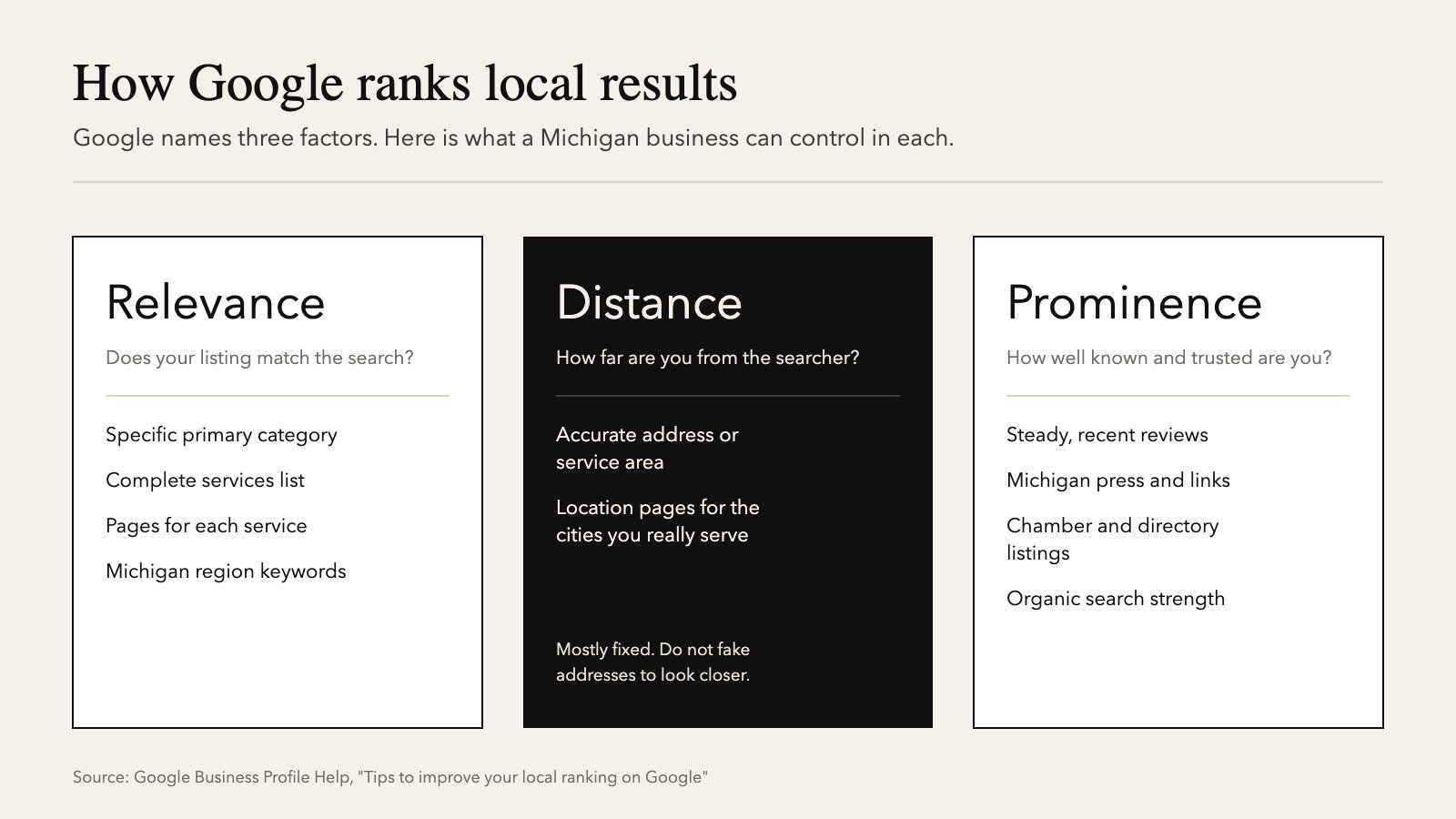
Google says local results are based mainly on relevance (how well your listing matches the search), distance (how far you are from the searcher or the location in the query), and prominence (how well known your business is, including reviews, links, and your position in regular web results) [1]. Google also states that you cannot pay to rank higher in local results [1].
Tactic 1: Treat your Google Business Profile like a storefront
For most Michigan businesses that serve local customers, the Google Business Profile drives more calls and visits than the website does. Get these right first.
- Pick the most specific primary category. “Personal injury attorney” beats “Lawyer.” Add secondary categories only if they truly apply.
- Use your real business name. Adding “Best Detroit Plumber” to your name when that is not your legal or storefront name breaks Google’s guidelines and can get the profile suspended [2].
- Keep name, address, and phone identical everywhere. Your website footer, Business Profile, Yelp, Apple Maps, Bing Places, and chamber listings should match exactly.
- Set an honest service area. List the counties and cities you really serve. A Grand Rapids landscaper does not need “all of Michigan.”
- Fill in services, products, and attributes. These add relevance for specific searches.
- Upload real photos every month. Your team, trucks, storefront, and finished work, in winter and summer.
- Update holiday hours. Thanksgiving, Christmas Eve, Fourth of July, and opening day of deer season if you close for it.
- Post updates. Seasonal offers, events, and project photos show the profile is active.
What changed: Google removed the public Questions and Answers section from Business Profiles in late 2025 and replaced it with an AI-powered “Ask” feature that answers from your profile, reviews, and website [3]. That makes a complete profile and a detailed FAQ on your website more important, because that is the information the AI draws from.
Tactic 2: Build reviews into your operations
Review count, recency, and your replies all feed prominence, and they decide who gets the click. A Lansing dentist with 40 reviews from this year usually gets the call over one with 200 reviews from 2021.
- Make the review request a step in your process, sent by text or email within 24 hours of the job.
- Use your direct review link from the Business Profile dashboard so it takes one tap.
- Reply to every review, positive or negative. When it fits naturally, mention the service and city: “Thanks for trusting us with your furnace replacement in Royal Oak.”
- Ask every customer, not just the happy ones.
Do not: pay or give discounts for reviews, filter out unhappy customers before asking (“review gating”), or post reviews written by AI or by staff. Google’s policy prohibits incentivized and fake reviews [5], and the FTC’s 2024 rule allows civil penalties for fake reviews and testimonials, including AI-generated ones [4].
Tactic 3: Research keywords the way Michiganders talk
Build your keyword list around counties, regions, local phrases, and seasons, not just city names. AI is excellent for brainstorming these variations. It cannot tell you real search volume, so confirm every phrase in Google Search Console or Google Keyword Planner before you build a page around it.
| Keyword type | Michigan examples | Best used on |
|---|---|---|
| County | Oakland County, Kent County, Washtenaw County, Macomb County | Service and location pages, especially legal, real estate, and home services |
| Region | Metro Detroit, West Michigan, Downriver, Up North, the U.P. | Home page, About page, Business Profile description |
| Local phrasing | party store, cottage, pop, Yooper | Blog posts and FAQs written in a natural voice |
| Seasonal | before winter, cottage opening, color tour, deer season | Seasonal blog posts and Business Profile updates |
| Intent | emergency, near me, open now, cost, best | Service pages and FAQs that answer the exact question |
Tactic 4: Build location and service pages that are not copy-paste
Duplicating one page fifty times and swapping the city name creates what Google calls doorway pages, which its spam policies specifically target [7]. Five useful location pages beat fifty thin ones. A strong Michigan location page includes:
- Neighborhoods, roads, or landmarks you actually work near (a Canton page might mention Ford Road or Heritage Park)
- Real projects from that area, with photos and results
- Reviews from customers in that city
- Local conditions: older housing in Dearborn and Detroit, lake-effect snow in Holland and Grand Rapids, wells and septic systems in rural counties
- A clear call to action with a tap-to-call phone number
Tactic 5: Get on-page and technical SEO right
None of the other Michigan SEO tactics work if Google cannot crawl, understand, and load your site quickly. Use this checklist on every important page.
| Element | What good looks like |
|---|---|
| Title tag | Main keyword near the front, city or region, brand at the end. About 50 to 60 characters so it is less likely to be cut off. |
| Meta description | A specific, honest summary of the page with a reason to click. Google may rewrite it, but a good one is often used [20]. |
| URL | Short, readable words separated by hyphens, like /michigan-seo-tactics/ [8]. |
| Headings | One H1 that matches the topic, then H2s for each section people would scan for. |
| Internal links | Link related pages with descriptive anchor text, for example AI techniques for Michigan marketers. |
| Structured data | LocalBusiness markup with your name, address, phone, hours, and geo coordinates [9]. |
| Speed | Core Web Vitals in the “good” range: LCP within 2.5 seconds, INP under 200 milliseconds, CLS under 0.1 [10]. |
| Mobile | Google indexes the mobile version of your site, so everything on desktop must also be on mobile [11]. |
| Images | Descriptive file names and alt text, compressed files, and real photos instead of stock [12]. |
| Contact info | Address and tap-to-call phone in the footer of every page, plus an embedded map on the contact page. |
Tactic 6: Go multilingual where Michigan customers need it
Census data shows Arab Americans now make up a majority of Dearborn’s residents [13]. Southwest Detroit has a large Spanish-speaking community, and Hamtramck is one of the most linguistically diverse cities in the state. If you serve these neighborhoods, translated pages can capture searches your competitors never see.
- Give each language its own URL, such as
/ar/or/es/, and connect them with hreflang tags [14]. - Use AI for the first draft, then have a native speaker review it before it goes live. Machine-only translation often reads badly and converts badly.
- Reply to reviews in the language the customer used.
Tactic 7: Earn Michigan links and mentions
Links and mentions from trusted Michigan sources are a strong prominence signal. One link from a respected Michigan publication is worth more than dozens of generic directory links.
- Chambers and business groups. Local chambers of commerce, downtown development authorities, and industry associations usually list members with a link.
- Local media. MLive, Crain’s Detroit Business, the Detroit Free Press, and regional TV stations. Pitch real news: an expansion, new jobs, a community project, or local data.
- Universities. Scholarships, internships, and guest lectures with schools like Wayne State, Michigan State, the University of Michigan, or Grand Valley State.
- Community sponsorships. Little League teams, 5Ks, and festivals often link to sponsors.
- Small business resources. The Michigan Small Business Development Center offers free consulting statewide [15], and the Michigan Economic Development Corporation publishes programs and success stories.
Never buy links or trade them in bulk. Google treats that as link spam and can ignore or penalize those links [7].
Tactic 8: Show up in AI search and answer engines
More searches now end in an AI answer: Google’s AI Overviews and AI Mode, ChatGPT, and other assistants. Google says there are no extra technical requirements for its AI features. A page has to be indexed and eligible to show a snippet in normal Search [16]. In practice, that means the same fundamentals, done clearly:
- Answer one question per section, answer first. “How much does a roof replacement cost in Michigan?” followed by the answer in the first sentence.
- Show real experience. Licenses, years in business, named team members, and first-hand project details [18].
- Be consistent across the web. AI tools rely on what other sites say about you, so reviews, press, and accurate directory listings all count.
- Do not chase special files or markup. You do not need new AI-only files or schema to appear in Google’s AI features [16].
The Michigan SEO and AI workflow
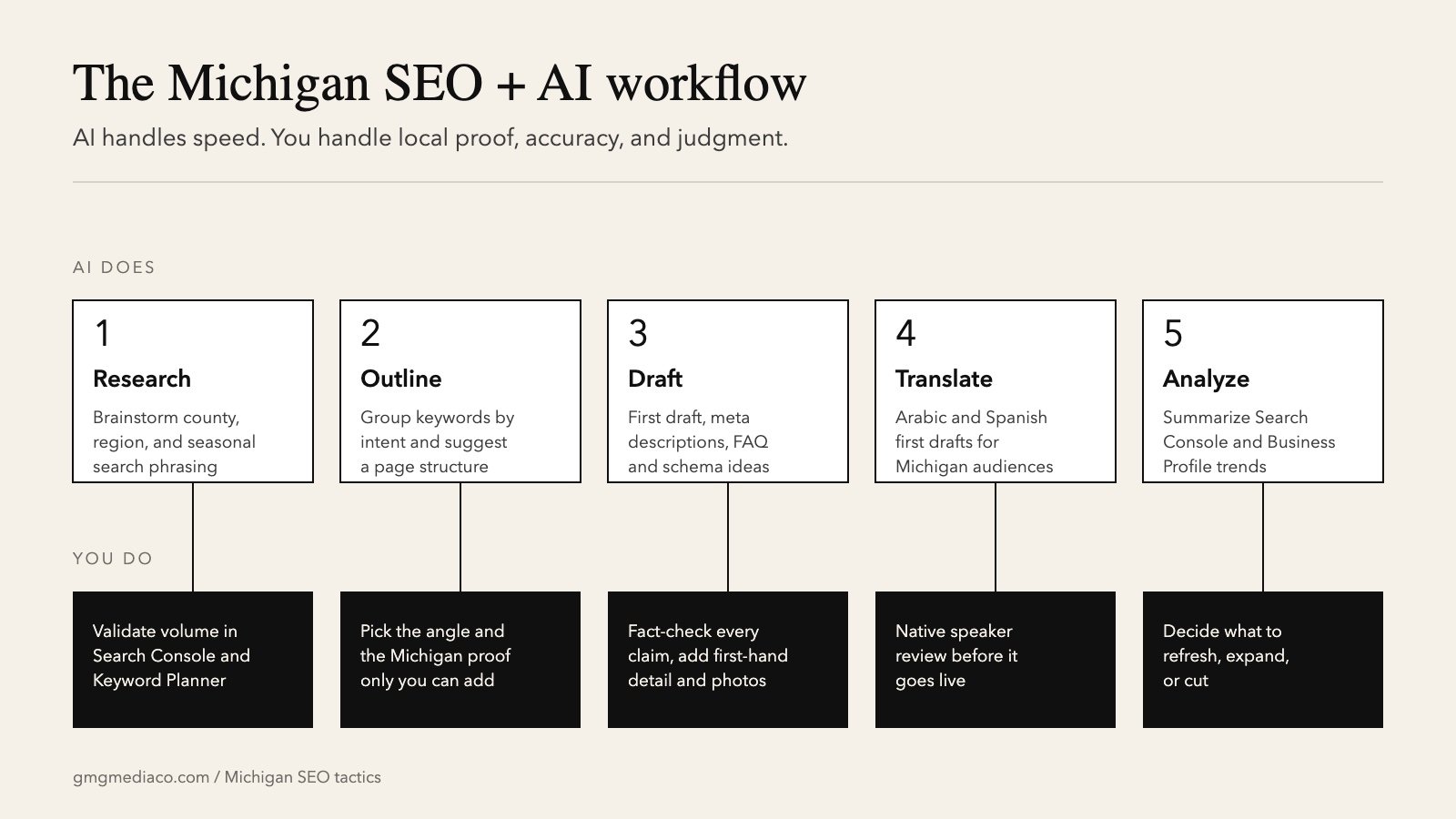
Google does not penalize content because AI helped write it. It penalizes content made mainly to manipulate rankings, including mass-producing pages with little value, which its spam policies call scaled content abuse [7] [17]. The safe approach is simple: let AI handle speed, and keep a human in charge of facts, local proof, and judgment.
| Task | Use AI? | Human check |
|---|---|---|
| Brainstorm county, region, and seasonal keywords | Yes | Confirm demand in Search Console or Keyword Planner |
| Outline a service or location page | Yes | Add local projects, photos, and reviews |
| Draft meta descriptions and FAQs | Yes | Make sure every answer is accurate for your business |
| Write customer reviews or testimonials | Never | Illegal under the FTC rule [4] |
| Translate pages | First draft only | Native speaker review |
| Summarize monthly performance | Yes | Decide what to refresh, expand, or remove |
Three prompts to start with. Replace the bracketed parts with your own details:
List 40 ways people in [county or region], Michigan might search for [service]. Group them by intent: urgent, research, price, and seasonal. Include local phrasing and county names. Do not invent search volumes.
Write an outline for a [service] page for customers in [city], Michigan. Leave marked gaps where I need to add a real local project, a customer review, and a photo.
Here is my Search Console export for the last 3 months. Show which Michigan city and county queries gained or lost clicks, and suggest which 3 pages to update first and why.
For a deeper look at prompts, translation, and compliance, read AI techniques for Michigan marketers.
Plan content around the Michigan search calendar
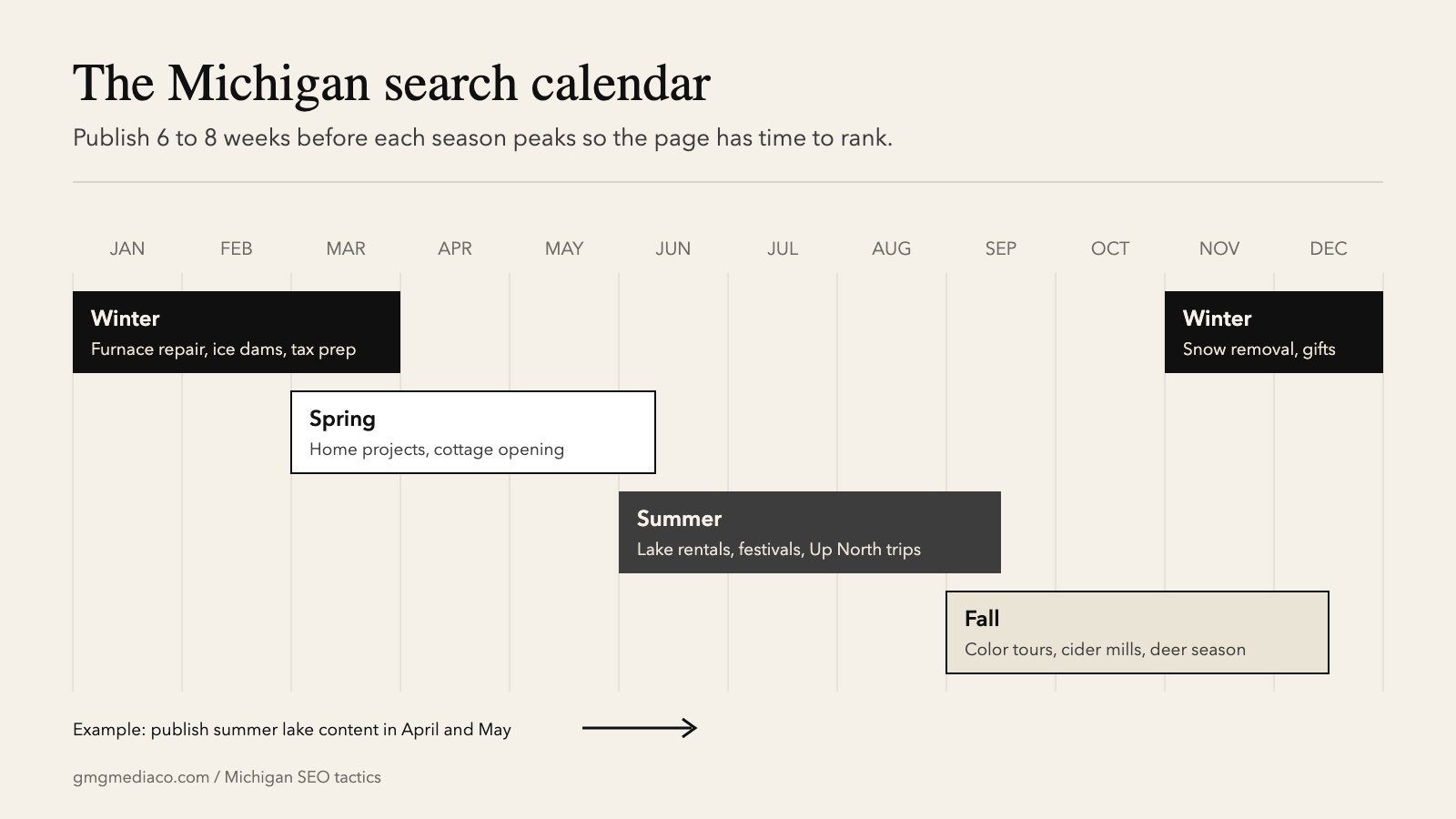
New pages usually need weeks to be crawled, indexed, and earn trust. Publish seasonal content six to eight weeks before demand peaks, and update last year’s seasonal posts instead of starting over.
| Months | What Michiganders search for | Publish by |
|---|---|---|
| January to February | Heating repair, ice dams, tax prep, indoor activities | Early November |
| March to April | Spring cleanup, home projects, trout opener | Late January |
| May to June | Cottage opening, boating, graduation parties | Late March |
| July to August | Lake trips, festivals, tourism, back to school | Mid May |
| September to October | Color tours, cider mills, hunting, winter prep | Mid July |
| November to December | Firearm deer season, holiday shopping, snow removal | Mid September |
How to profit more from Michigan SEO
Rankings only matter if they turn into revenue. These steps connect SEO work to money.
- Know what a lead is worth. Multiply your average job value by your close rate. Illustrative example: a $4,000 job closed 25% of the time makes each qualified lead worth about $1,000. Now you can judge whether a page or a month of SEO paid off.
- Prioritize high-margin services and areas. Build your best pages for the services and counties that earn the most, not the ones that are easiest to rank.
- Make contacting you effortless. Tap-to-call buttons, a short form, and replies within an hour. A ranking is wasted if the lead calls the next business.
- Refresh your winners. Updating a page that already ranks on page two is often faster than writing a new one.
- Track by source. Set up calls, form submissions, and direction requests as conversions so you can see which pages and cities produce paying customers.
What most Michigan businesses can do better
| Common mistake | Do this instead |
|---|---|
| “Serving all of Michigan” on every page | Name the counties, cities, and regions you really serve |
| Business Profile set up once and forgotten | Monthly photos, updates, and holiday hours |
| Asking for reviews only when someone remembers | An automatic review request after every job |
| Fifty city pages with the same text | Five strong pages with local proof |
| Publishing AI drafts without editing | Fact-check, add first-hand detail, then publish |
| Writing about summer in June | Publishing summer content in April |
| Watching rankings only | Tracking calls, forms, and booked jobs |
Your 30-day Michigan SEO plan
A 30-day plan to put these Michigan SEO tactics into practice:
- Week 1, foundation. Claim and complete your Business Profile. Verify your site in Google Search Console. Make your name, address, and phone match everywhere.
- Week 2, keywords and pages. Use AI to brainstorm county and region keywords, confirm them in Search Console, and improve the titles, headings, and meta descriptions on your top five pages.
- Week 3, reviews and links. Start an automatic review request. Join or update your chamber of commerce listing. List one sponsorship or community partnership.
- Week 4, content and tracking. Publish one seasonal post for the next Michigan peak. Add LocalBusiness structured data. Set up conversion tracking for calls and forms.
Putting these Michigan SEO tactics together
You do not need to do everything at once. The Michigan SEO tactics with the fastest payoff are a complete Google Business Profile, a steady review process, and service pages that name the real counties and cities you serve. Add seasonal content and Michigan links next, and use AI to speed up the work, not to replace your judgment. Revisit this list every quarter, because Michigan SEO tactics keep changing as Google and AI search change.
Michigan SEO tactics: 10 frequently asked questions
What are the most effective Michigan SEO tactics for a small business?
Start with a complete Google Business Profile, a steady flow of genuine reviews, and service pages that name the Michigan counties and cities you really serve. Those three improve relevance and prominence, the two local ranking factors you control [1].
How long does it take for local SEO to work in Michigan?
Business Profile improvements can show results within weeks. New pages often take a few months to rank, and competitive markets like Detroit, Grand Rapids, and Ann Arbor take longer than smaller towns. That is why seasonal content should go live six to eight weeks early.
Do I need a separate page for every Michigan city I serve?
No. Build pages only for your most valuable areas, and make each one genuinely different with local projects, reviews, and conditions. Near-identical city pages can be treated as doorway pages under Google’s spam policies [7].
Can I use AI to write SEO content for my Michigan business?
Yes. Google judges content by its quality and usefulness, not by how it was made [17]. Use AI for research and drafts, then fact-check it and add local detail only you can provide. Mass-producing low-value pages is scaled content abuse, whether a person or AI writes them [7].
Should I add “Michigan” or my city to my Google Business Profile name?
Only if it is part of your real business name as it appears on your signage and paperwork. Adding keywords or locations that are not part of your name breaks Google’s guidelines and can lead to suspension [2]. Put locations in your description, services, and website instead.
How can I get more Google reviews without breaking the rules?
Ask every customer soon after the job with your direct review link, and make it part of your normal process. Never offer discounts or gifts for reviews, never filter out unhappy customers before asking, and never post fake or AI-written reviews [4] [5].
What happened to the Q&A section on Google Business Profiles?
Google phased out public Questions and Answers in late 2025 and replaced it with an AI “Ask” feature that answers from your profile, reviews, and website [3]. Keep your profile complete and publish a clear FAQ on your site so the answers are accurate.
Does adding an FAQ section still help SEO?
Yes, for people and for AI answers. Since 2023, Google shows FAQ rich results mainly for well-known government and health websites [19], so most businesses will not get the expandable FAQ in search results. A good FAQ still answers real questions and gives search engines and AI tools clear answers to pull from.
How do I show up in Google AI Overviews and ChatGPT answers?
Make sure your pages are indexed, answer specific questions clearly, show real experience, and keep your business information consistent across the web. Google says its AI features have no special requirements beyond normal Search eligibility [16].
How do I know if my Michigan SEO is working?
Check Google Search Console for clicks and impressions on Michigan city and county queries [6], and your Business Profile performance report for calls, website clicks, and direction requests. The real test is whether calls, forms, and booked jobs from search go up.
Keep learning
- AI techniques for Michigan marketers: prompts, translation, and compliance
- Marketing in Michigan: how to reach Michigan consumers with AI and SEO
- All posts on the blog: new Michigan marketing guides every week
Sources
- Tips to improve your local ranking on Google. Google Business Profile Help.
- Guidelines for representing your business on Google. Google Business Profile Help.
- Google Business Profile Q&A. BrightLocal, updated 2026.
- FTC announces final rule banning fake reviews and testimonials. Federal Trade Commission, August 2024.
- Prohibited and restricted content: fake engagement. Google Maps user contributed content policy.
- Google Search Console. Google.
- Spam policies for Google web search. Google Search Central.
- URL structure best practices for Google. Google Search Central.
- Local business structured data. Google Search Central.
- Web Vitals. web.dev, Google.
- Mobile site and mobile-first indexing best practices. Google Search Central.
- Image SEO best practices. Google Search Central.
- Census data shows Arab American population in Dearborn now a majority. WDIV ClickOnDetroit, 2023.
- Tell Google about localized versions of your page. Google Search Central.
- Michigan Small Business Development Center. Michigan SBDC.
- AI features and your website. Google Search Central.
- Google Search’s guidance on using generative AI content on your website. Google Search Central.
- Creating helpful, reliable, people-first content. Google Search Central.
- Changes to HowTo and FAQ rich results. Google Search Central Blog, August 2023.
- Control your snippets in search results. Google Search Central.