
In Michigan, what people search for changes with the weather. Furnace repair in January, cottage opening in May, color tours in October. The businesses that win those searches publish before the season, not during it. This guide shows how to build a Michigan seasonal SEO calendar, month by month, and how it fits into the bigger Michigan SEO tactics playbook.
Quick answer
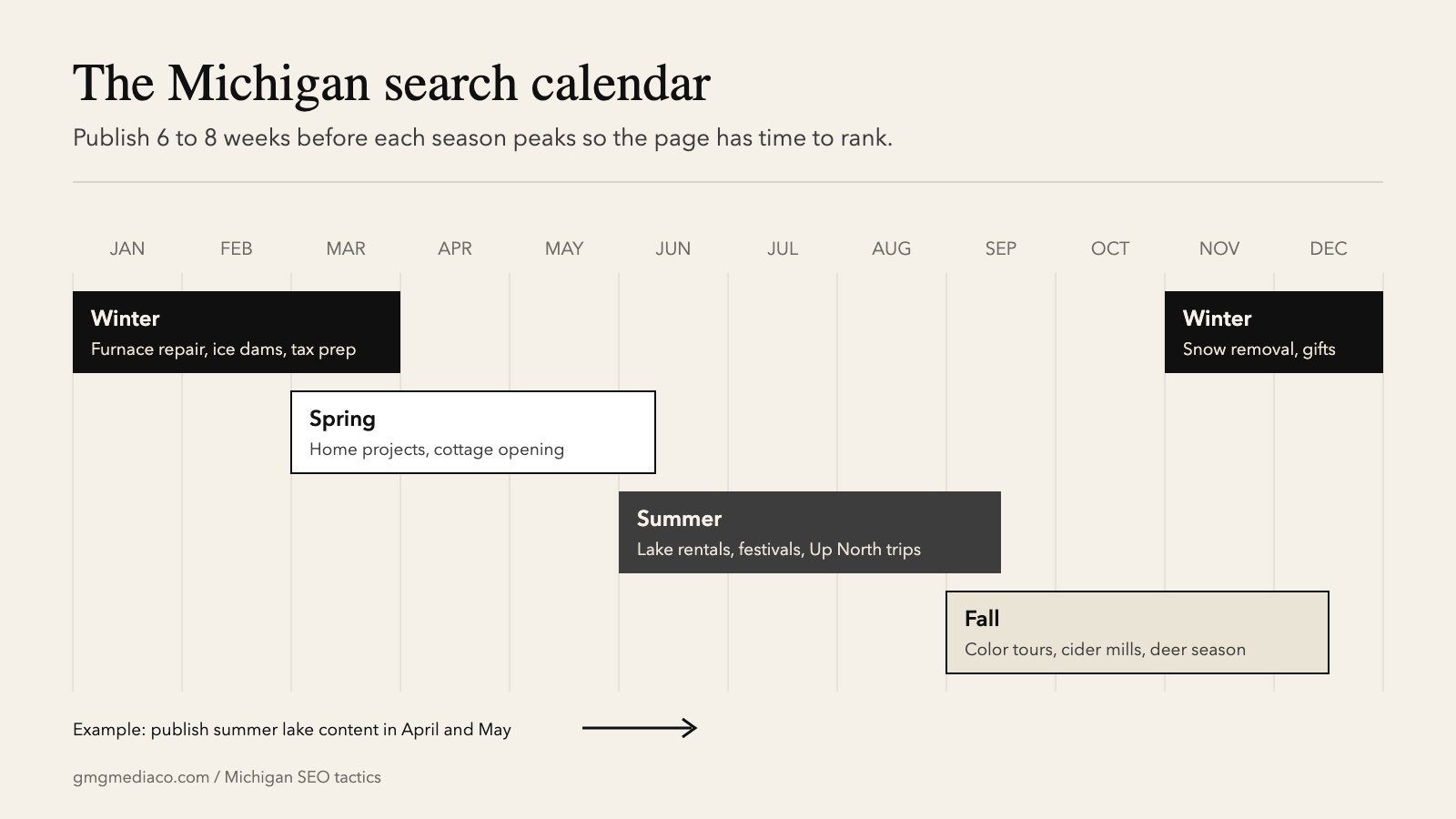
Publish or refresh seasonal pages six to eight weeks before Michigan demand peaks, keep the same URL every year, and confirm timing with Google Trends and your own Search Console data [1] [2].
Why you have to publish early
A new page has to be discovered, crawled, indexed, and trusted before it ranks well, and that usually takes weeks. If you publish your snow removal page when the first storm hits, your competitor’s page from last year is already in the results. Publishing six to eight weeks early gives your page time to be found before searches spike.
Tourism makes the swings even bigger. Michigan drew about 130 million visitors who spent roughly $30 billion in 2024 [3], and most of that travel clusters around summer and fall.
The Michigan seasonal SEO calendar
| Peak months | What Michiganders search for | Content ideas | Publish by |
|---|---|---|---|
| January to February | Furnace repair, ice dams, frozen pipes, tax prep, ski trips | “How to prevent ice dams in Michigan,” emergency service pages | Early November |
| March to April | Spring cleanup, roof repair, trout opener, maple syrup | Spring home checklist, “after winter” damage guides | Late January |
| May to June | Cottage opening, boating, graduation parties, Memorial Day travel | Cottage opening checklist, grad party planning guide | Late March |
| July to August | Lake trips, festivals, Up North travel, back to school | Local festival guides, “things to do Up North” pages | Mid May |
| September to October | Color tours, cider mills, hunting, furnace tune-ups | Color tour routes, winter prep checklists | Mid July |
| November to December | Firearm deer season, holiday shopping, snow removal contracts | Holiday gift guides, snow removal service pages | Mid September |
How to build your own calendar in five steps
- Find your real peaks. In Google Search Console, compare clicks month by month for the past 16 months [2]. In Google Trends, set the region to Michigan and check your main service terms over five years [1].
- Count back six to eight weeks. That is your publish date. Put it on a shared calendar with an owner.
- Use one evergreen URL per season. Use
/michigan-cottage-opening-checklist/, not/cottage-opening-2026/. Update the same page each year so it keeps its links and history. - Add local proof. Real photos, Michigan place names, and details from your own jobs. This is what separates your page from generic content [4].
- Promote it everywhere. Post it on your Google Business Profile, link it from your service pages, and share it in your email newsletter.
Using AI to speed up seasonal content
AI can turn one seasonal brief into a blog outline, three Business Profile posts, email subject lines, and social captions in minutes. Use it for options, then have a person check every date, event name, and price. Google is fine with AI-assisted content when it is helpful and accurate [5]. Try this prompt:
I run a [business type] in [city], Michigan. Our busy season is [months]. Create a content plan for the 8 weeks before it starts: one blog post outline, three Google Business Profile posts, and two email subject lines. Use Michigan regional terms where they fit. Do not invent events, dates, or prices.
For more prompts and guardrails, see AI-built seasonal campaigns.
How Michigan seasonal SEO increases profit
- Fill the slow season. Content that ranks early books jobs before the rush, which smooths out cash flow.
- Win the peak without extra ad spend. When searches spike, organic rankings bring customers you do not pay per click for.
- Sell the next season. A fall furnace tune-up page can offer a winter service plan, turning one visit into a recurring customer.
Michigan seasonal SEO is a habit, not a one-time project. Put your publish dates on the calendar now, and next year you will only need to refresh pages that already rank.
Frequently asked questions
How far ahead should I publish seasonal content in Michigan?
Six to eight weeks before demand peaks. For competitive topics or brand new websites, give it even longer.
Should I put the year in the URL of a seasonal post?
No. Keep one evergreen URL and update the content and title each year. A dated URL makes you start over every season.
How do I know when my busy season starts in search?
Check Google Trends with the region set to Michigan [1], and compare month-by-month clicks in Search Console [2]. Your own data is the best guide.
Does Up North content need different timing than Metro Detroit?
Often, yes. Northern Michigan and the U.P. get snow earlier and spring later, and tourism peaks are sharper. Check Trends for those regions separately and plan their content a few weeks earlier in fall.
Keep learning
- Michigan SEO tactics: the full local search playbook
- Google Business Profile Michigan checklist
- AI techniques for Michigan marketers
Sources
- Google Trends. Google.
- Google Search Console. Google.
- Increase in tourism across Michigan, report says. WLUC TV6, August 2025.
- Creating helpful, reliable, people-first content. Google Search Central.
- Google Search’s guidance on using generative AI content on your website. Google Search Central.